
Menu
Menu

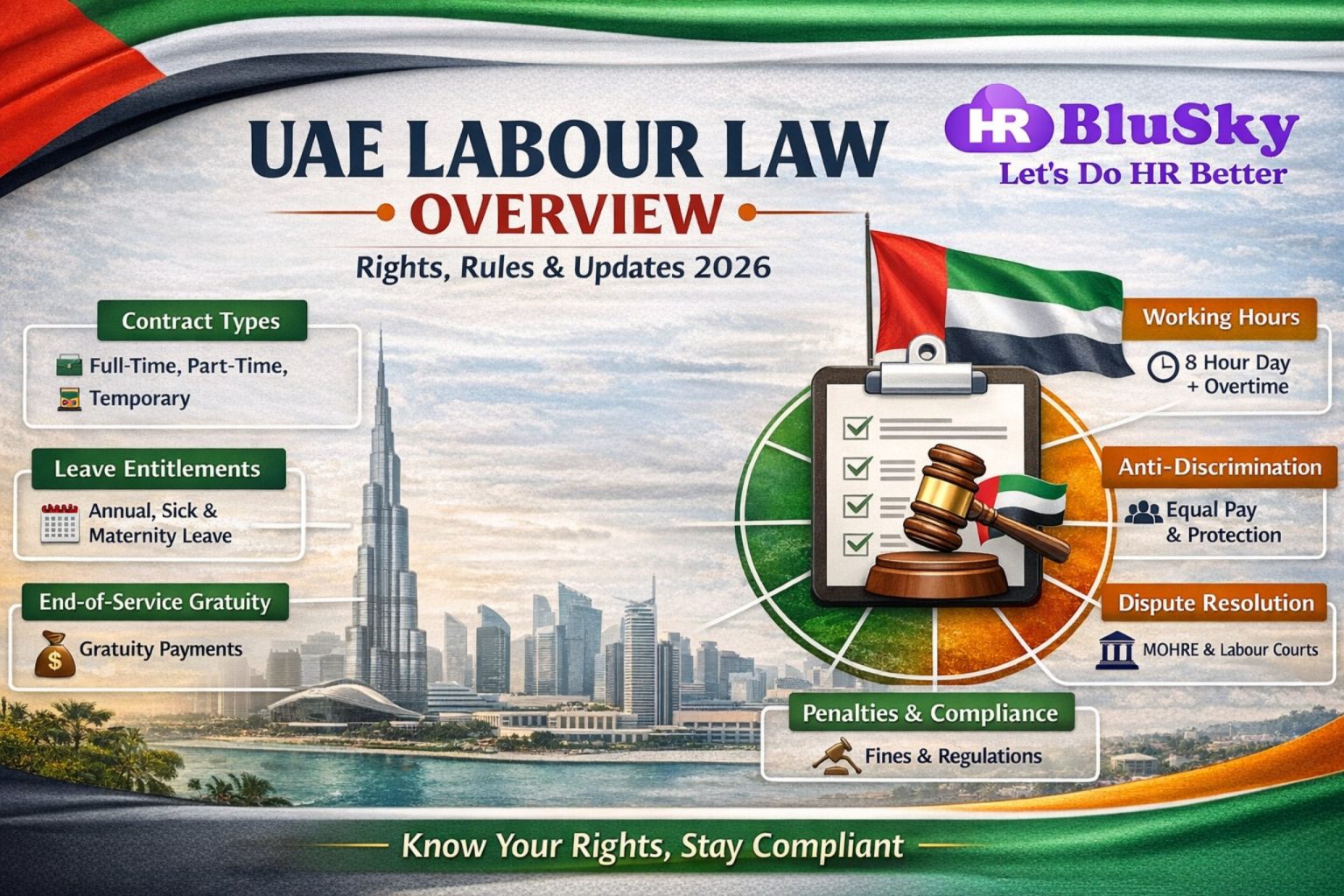
The UAE Labour Law, officially known as Federal Decree-Law No. 33 of 2021, represents the most significant overhaul of employment legislation in the United Arab Emirates in decades. This modern framework, which came into effect on 2 February 2022, replaced the old Federal Law No. 8 of 1980 and introduced a more flexible, balanced and globally aligned system governing employment relationships in the private sector.
UAE Labour Law applies to most employees in the private sector, including both UAE nationals and expatriates. Certain categories, such as government employees and those under separate free zone laws (e.g., DIFC and ADGM), are governed by different employment frameworks.
The law has abolished unlimited contracts and mandates fixed-term contracts as the default model, typically renewable every three years or shorter by mutual agreement.
Full-time – Standard employment
Part-time – Work based on specified hours/days
Temporary – Project-based or specific duration
Flexible/Remote – Modern work arrangements to suit market needs
Standard working time remains at about eight hours per day, though some models allow variations such as condensed hours. Overtime is permitted, but restricted to 2 hours per day, and total working hours must not exceed defined limits over multi-week periods.
Employees are entitled to weekly rest days and public holidays. If an employee is required to work on a holiday, they are generally entitled to a replacement day off or higher compensation.
The law provides robust leave benefits, including:
Annual Leave: At least 30 calendar days after one year of service.
Sick Leave: Up to 90 days, dependent on service length and documentation.
Maternity Leave: Enhanced in recent years, recently discussed policy proposals may further extend this benefit.
Paternity Leave: Available for eligible employees.
Under the current labour law, discrimination on the basis of race, colour, sex, religion, national origin, or disability is explicitly prohibited. Employers must ensure equal pay for equal work and protect employees from bullying, harassment, forced labour, and any form of abuse.
The law also prohibits employers from withholding personal documents such as passports, and requires that such materials be returned at the end of employment to allow worker mobility within the labour market.
Employees who complete at least one year of service are entitled to end-of-service gratuity. This is typically calculated based on the basic wage — usually 21 days for each of the first five years, and 30 days for each subsequent year, subject to certain caps.
Court rulings have reinforced that attempts to waive these statutory rights before termination are invalid.
The law has evolved to provide clearer dispute processes. In many cases, claims under a specified amount (e.g., AED 50,000) can be decided by the Ministry of Human Resources and Emiratisation (MOHRE), and final disputes are adjudicated by UAE courts. Deadlines for filing claims are extended to two years after employment termination.
Recent amendments in 2024 and beyond have significantly increased fines for violations such as employing without permits, failing to settle dues, or breaching anti-discrimination rules. Penalties may now range between AED 100,000 and AED 1,000,000 depending on the seriousness of the breach.
The UAE is continually updating labour policies. For instance:
Minimum wage guidelines for UAE nationals in the private sector are being introduced.
Discussions are underway to extend maternity leave benefits potentially to the private sector.
These evolving reforms aim to make the UAE labour market more competitive, equitable and aligned with modern workforce expectations.
UAE Labour Law has transformed the employment landscape by introducing a modern, flexible, and worker-protective framework. From varied contract types and enhanced leave entitlements to strict anti-discrimination norms and stronger enforcement mechanisms, both employers and employees must stay informed of their rights and responsibilities under the current regime.
If you operate or work in the UAE, understanding these laws is essential to ensure compliance and safeguard workplace harmony — and professional legal advice is often recommended for complex cases.
Alignment
Article
Audit
Automation
Benefits
Candidate
Communication
Compliance
Digitalisation
Digital Technology
Diversity
Emirates Id Application
Employee Experience
ESS
Feedback
Health and Safety
HRMS
HR Strategy
HR System UAE
Human Resource Management
Human Resource Management Systems
Job Roles
Learning and Development
Onboarding
Outsource
Payroll
Payroll Management System
Payroll Processing
Performance
Performance Management
Personalisation
Recruit
Recruiting
Recruitment
Remote Working
Rewards
Security
Service Providers
Skills
Smart
Survey
Virtual
Visa Cancellation
Work Environment
Workforce
© 2026 Pruvity HR Solutions Pvt Ltd, Madurai, India